
Rural clinics and disaster response, where the nearest lab is a drive away.
Tetrel Health
Advancing the frontline of diagnostics
Bedside, battlefield, or the back of an ambulance
Synthetic protein switches for biomarker detection
Read out electrically. No dyes, no wash steps, no second reagent.
The mission
Clinical-grade diagnostics at the point of need
A crew in an ambulance, a medic far forward, a clinician hours from the nearest lab. Each makes the call before the chemistry exists.
Put a clinical-grade answer where the decision is made, rather than where the instrument lives.
No lab, no cold chain, evacuation measured in hours or days.
Where the destination decision is made, with no blood chemistry available.
Technology
Design the molecule, and the instrument gets simple.
Most of the complexity in a blood test sits in the machine around the chemistry. We put it in the protein.
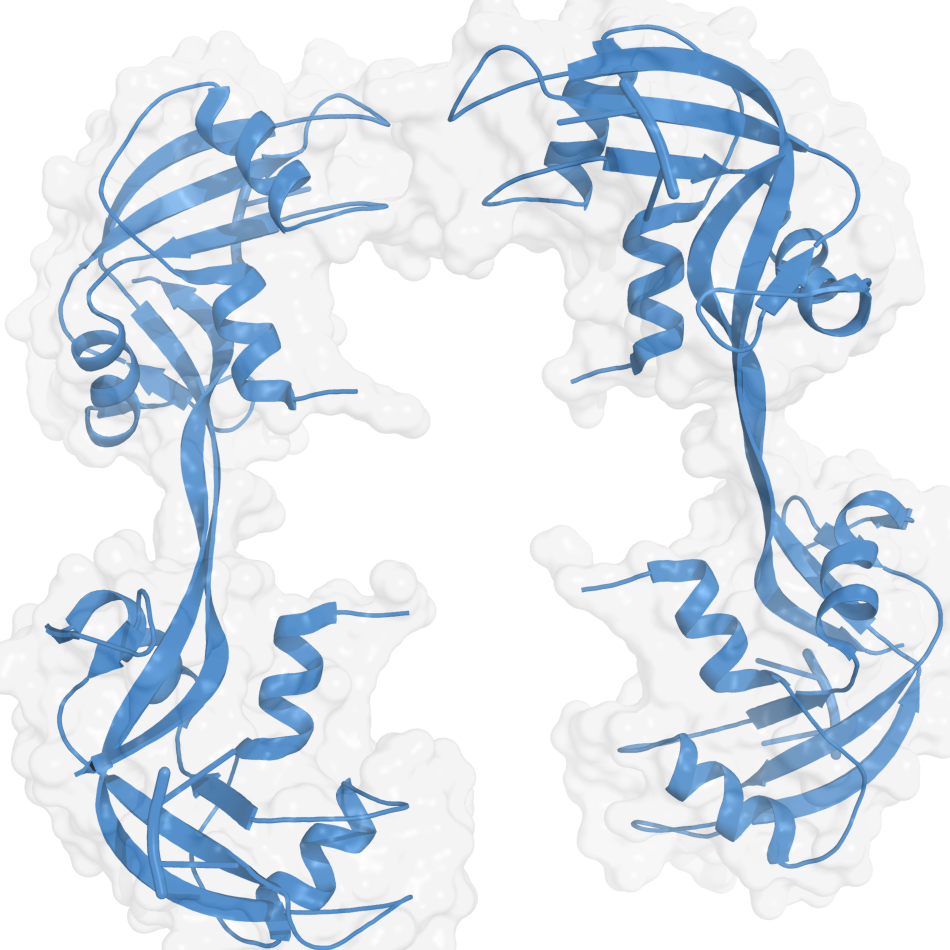
A protein switch
A designed protein that changes shape when it meets its target. That movement is the signal. No label step, nothing to add.
An electrical readout
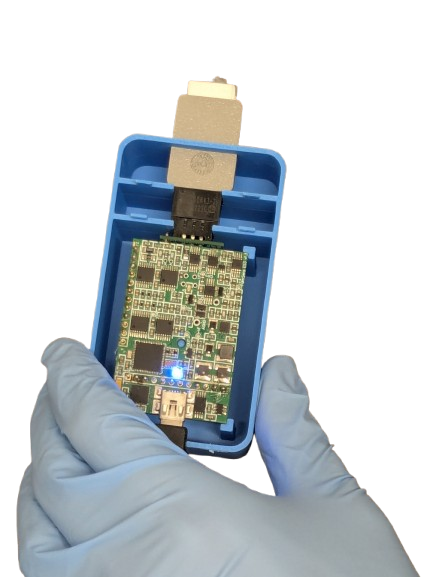
The shape change is read directly as an electrical signal. That keeps the reader small: no optics, no moving parts.
A single-use ambient cartridge
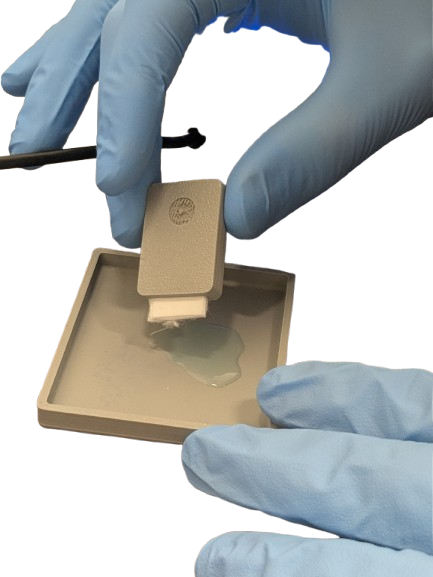
Reagents dried onto the sensor, so the cartridge is designed to be stored at ambient temperature and the reader carries no wet chemistry.
Generated, scored, narrowed, built
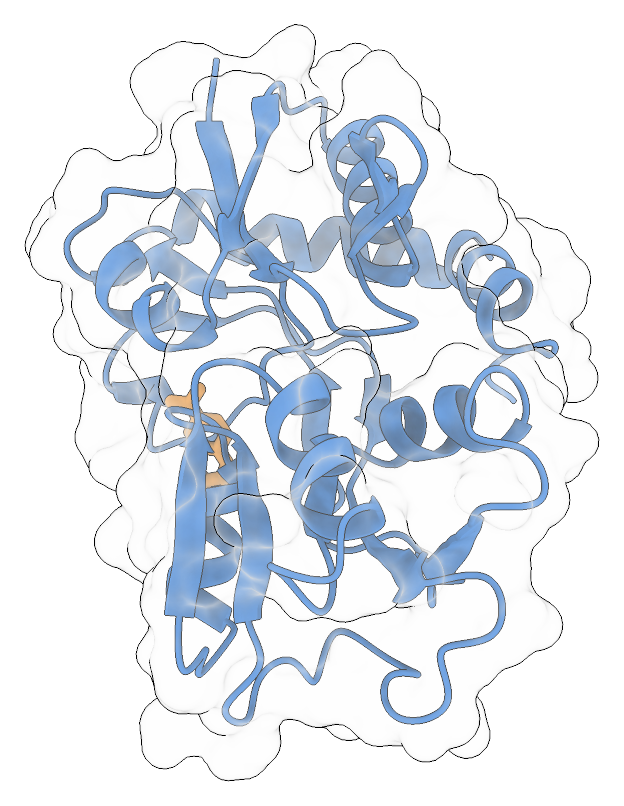 Off
Off 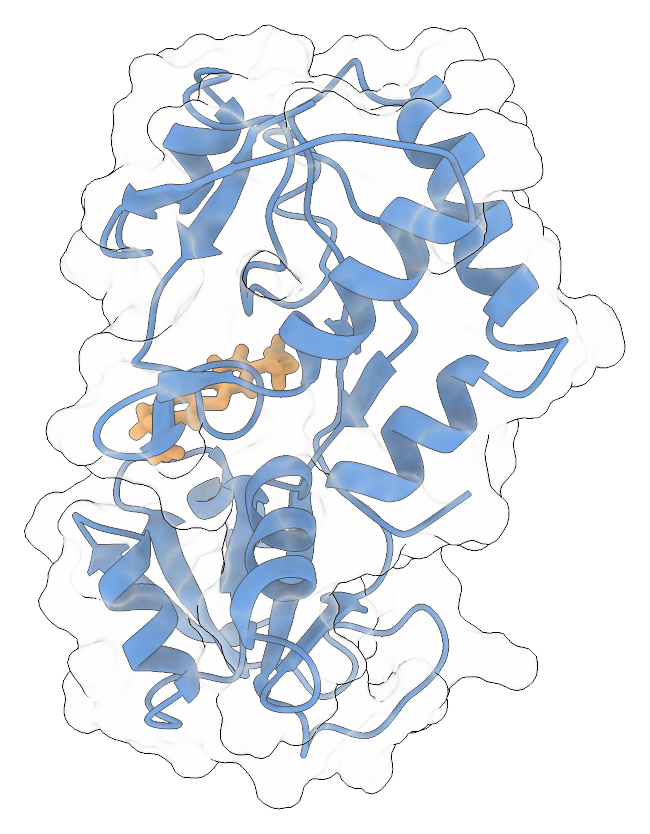 On
On Two states, and the target decides which
The switch sits off until its target is present. Binding moves it to on, and that movement is the signal we read.
The molecule is both the sensor and the switch.
Specify
What the protein has to recognise, and what it does about it
Generate
Candidate structures and sequences, computationally, in volume
Simulate
Model how each behaves and rank them. Most do not survive.
Build and measure
Express the survivors and test them. A measurement decides.
The pipeline is not specific to sensing. It makes proteins that perform a defined function, and we point it at diagnostics first, because that is where a small, fast, reagentless readout changes what is possible outside a laboratory.
We also run it against other people's targets. Talk to us about protein design services
Applications
At the point of need
01 · Prehospital EMS
The answer arrives in the ambulance
The destination decision is made on scene, today with no blood chemistry, because the analysis needs a laboratory the ambulance does not carry.
- Results while the patient is still in the vehicle
- No refrigeration on a vehicle with no cold chain
- One-handed operation by an occupied crew
02 · Military and far-forward
Forward, and unsupported
Every constraint at once: no laboratory, no power or cold chain, evacuation in hours or days, a medic triaging more than one casualty.
- Ambient storage, so the kit survives being carried rough
- Self-contained, with no external instrument
03 · Austere and rural
When the nearest lab is a drive away
The same problem on a longer clock. Samples are batched and sent; the result arrives after the patient has gone.
- A result inside the visit rather than after it
- Minimal training; the operator is not a lab technician
- Cost per test low enough to deploy widely
The team
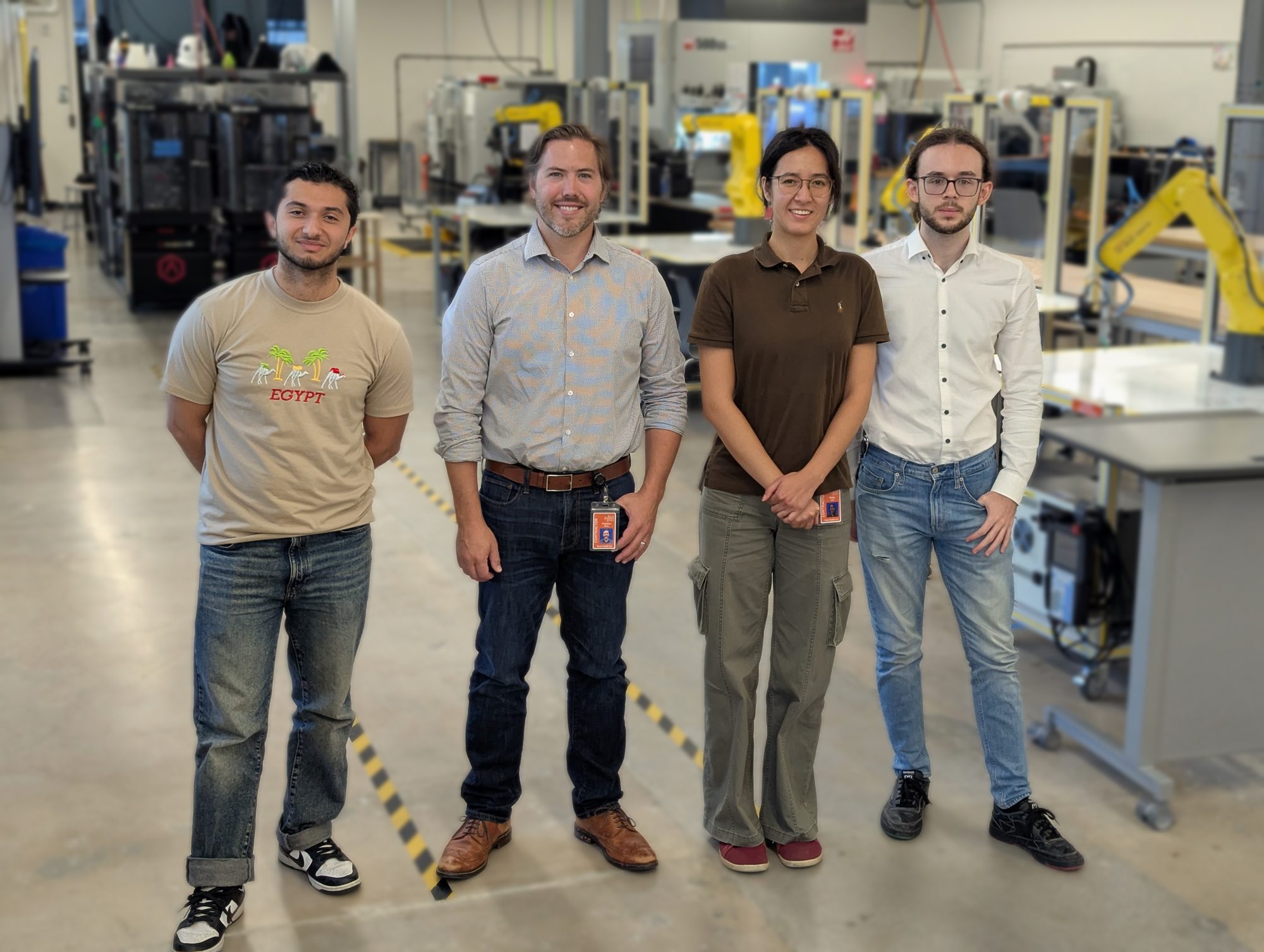
A small team that builds its own things.
Protein design, sensing electronics and the hardware around both, in-house.

Creighton Buie, P.E.
Founder & Chief Executive Officer
Chemical and materials engineer, master's from UT Dallas, licensed Texas Professional Engineer.
Thirteen years building diagnostics on semiconductor electronics: sensor R&D at Ion Torrent and Thermo Fisher, 2013–2018, then VP of Engineering at Avails Medical, 2018–2026, where the team took a 510(k)-cleared product through to clearance.

Eric Anslyn, PhD
Scientific Advisor
Welch Regents Chair in Chemistry at UT Austin, a leading figure in synthetic chemical sensors and molecular recognition. He advises on the chemistry of the switch and its reporter.
Full advisory team, including business and clinical advisors, not shown here
How we work
Design control from the start
Needs, requirements, components and their bill of materials sit in a traceable cascade, one named owner per item. Controlled-change logging and a design history file run now, sized to the stage. Computational work ranks and prioritises; a measurement decides.
Evidence
What is already established
The clinical need
Why a result that arrives sooner, closer to the patient, is worth engineering for.
8 papers
-
Puts a number on how fast neural tissue is lost in acute stroke.
-
Established blood GFAP and UCH-L1 as informative in acute traumatic brain injury.
-
Diagnostic Performance of GFAP, UCH-L1, and MAP-2 Within 30 and 60 Minutes of Traumatic Brain Injury
These markers in the earliest window after injury, the window a point-of-need test occupies.
-
GFAP point-of-care measurement for prehospital diagnosis of intracranial hemorrhage in acute coma
GFAP measured prehospital, in the ambulance rather than the hospital.
-
Prospective validation of GFAP alongside clinical scales in cerebrovascular disease.
-
Redefining Mild Traumatic Brain Injury (mTBI) delineates cost effective triage
Triage practice in mild traumatic brain injury, and where imaging is used.
-
Budget-impact analysis of GFAP and UCH-L1 in mild traumatic brain injury.
-
Fourth Universal Definition of Myocardial Infarction (2018)
The consensus definition of myocardial infarction, which sets how cardiac markers are read.
Designing proteins to order
The work that made it possible to design a new protein for a specified job.
7 papers
-
De novo design of protein structure and function with RFdiffusion
De novo design of protein structure and function using diffusion models.
-
Improving de novo protein binder design with deep learning
Designing proteins that bind a chosen target.
-
Accurate structure prediction of biomolecular interactions with AlphaFold 3
Structure prediction extended to biomolecular interactions.
-
One-shot design of functional protein binders with BindCraft
Functional binders without an experimental screening loop.
-
Atomic context-conditioned protein sequence design using LigandMPNN
Sequence design conditioned on atomic context, including bound ligands.
-
Generalized biomolecular modeling and design with RoseTTAFold All-Atom
Generalized modelling and design across biomolecular types.
-
Artificial allosteric protein switches with machine-learning-designed receptors
Artificial allosteric protein switches from machine-learning-designed receptors.
Reading a protein electrically
Prior art that a conformational change at an electrode can be measured directly.
9 papers
-
Label-Free Electronic Detection of Thrombin in Blood Serum by Using an Aptamer-Based Sensor
Label-free electronic detection of a protein target in blood serum.
-
An electrochemical sensor reporting a small molecule with no added reagents.
-
A growth factor detected at picomolar levels in a complex sample.
-
Folding-Based Electrochemical Biosensors: The Case for Responsive Nucleic Acid Architectures
The folding-based architecture behind reagentless electrochemical biosensors.
-
A protein-folding biosensor architecture supporting real-time measurement.
-
Electrodetection of Small Molecules by Conformation-Mediated Signal Enhancement
Electrodetection where a conformational change enhances the signal.
-
Reagentless biosensing using unnatural amino acids on the recognition element.
-
Survey of Redox-Active Moieties for Application in Multiplexed Electrochemical Biosensors
Redox-active reporters available for electrochemical biosensors.
-
Methylene blue as an electrochemical reporter: history and mechanism.
When we have measured data on our own constructs, it will appear here with its method, its conditions, and what it does not show.
Talk to us
We read everything that arrives. Investors, federal partners, advisors and clinicians who work outside a laboratory are the conversations we want.